THE MIURA FOLD
Open it with one pull
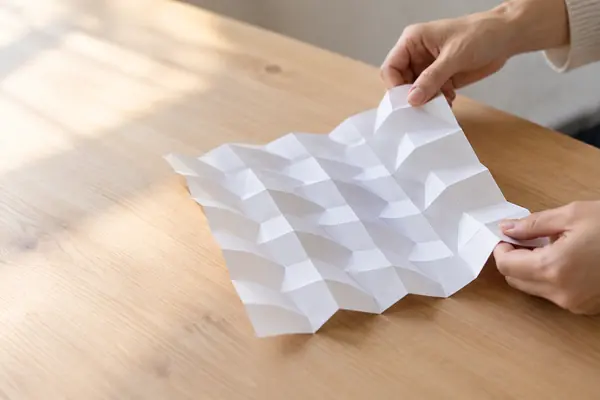
Invented by Japanese astrophysicist Koryo Miura, this grid of parallelograms opens and closes in one motion. It has been used for tourist maps and a solar panel on a 1995 satellite.
Pick a fold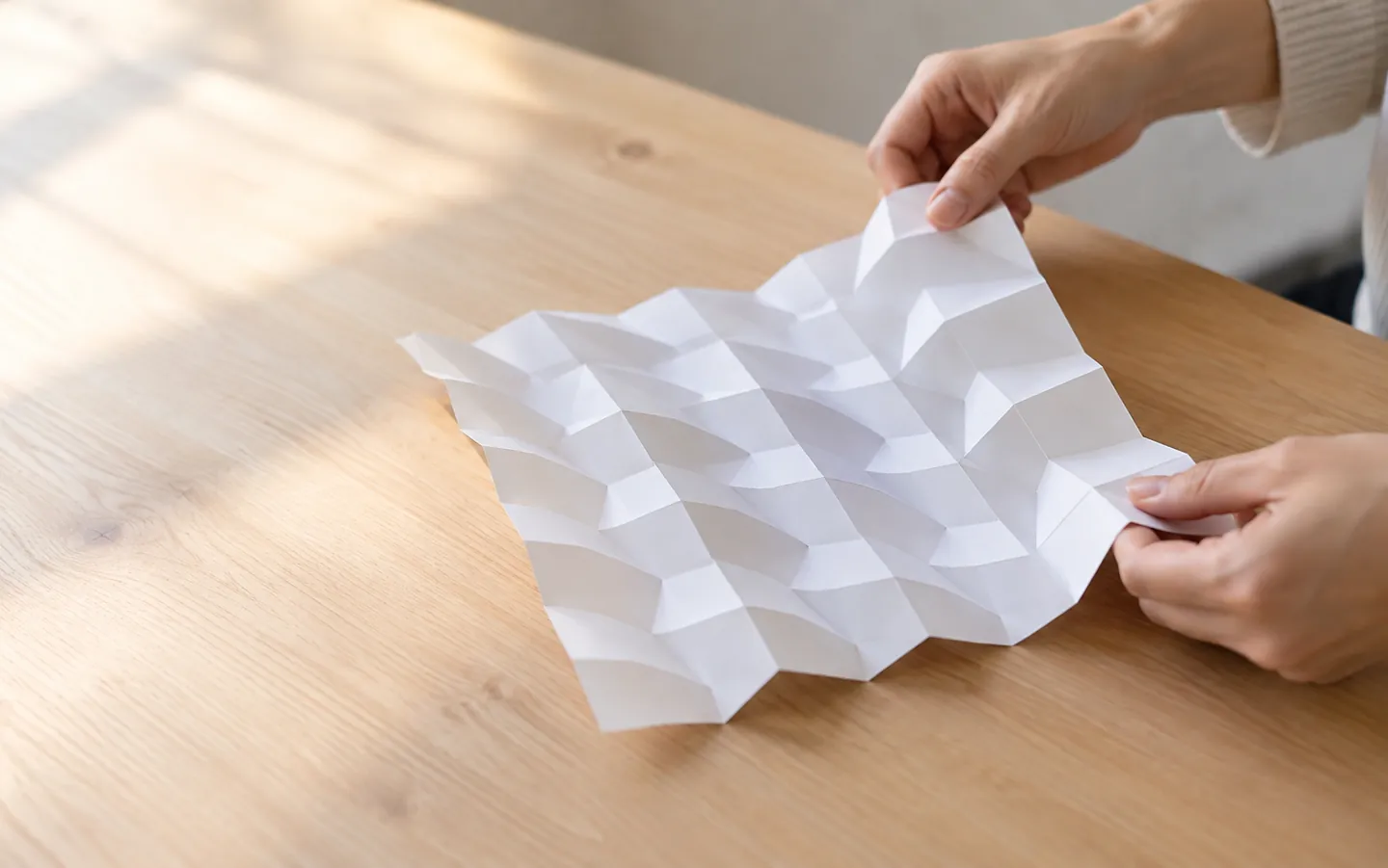
THE ENGINEERING OF FOLDS
ONE PULL to open a Miura fold
AI-generated image, not a photograph of a real person or place.
A crease is a hinge you can draw on paper.
Origami artists found rules for which crease patterns fold flat. Engineers now use the same geometry to pack solar arrays, sunshields and tubes into tight spaces and open them again with very little effort.
THE SHORT ANSWER
In rigid folds the panels never bend:
they only turn about the creases, like hinges.
THE MIURA FOLD
Invented by Japanese astrophysicist Koryo Miura, this grid of parallelograms opens and closes in one motion. It has been used for tourist maps and a solar panel on a 1995 satellite.
Pick a foldSPACE
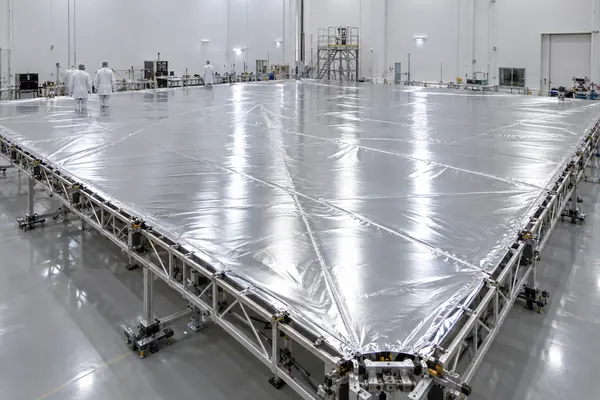
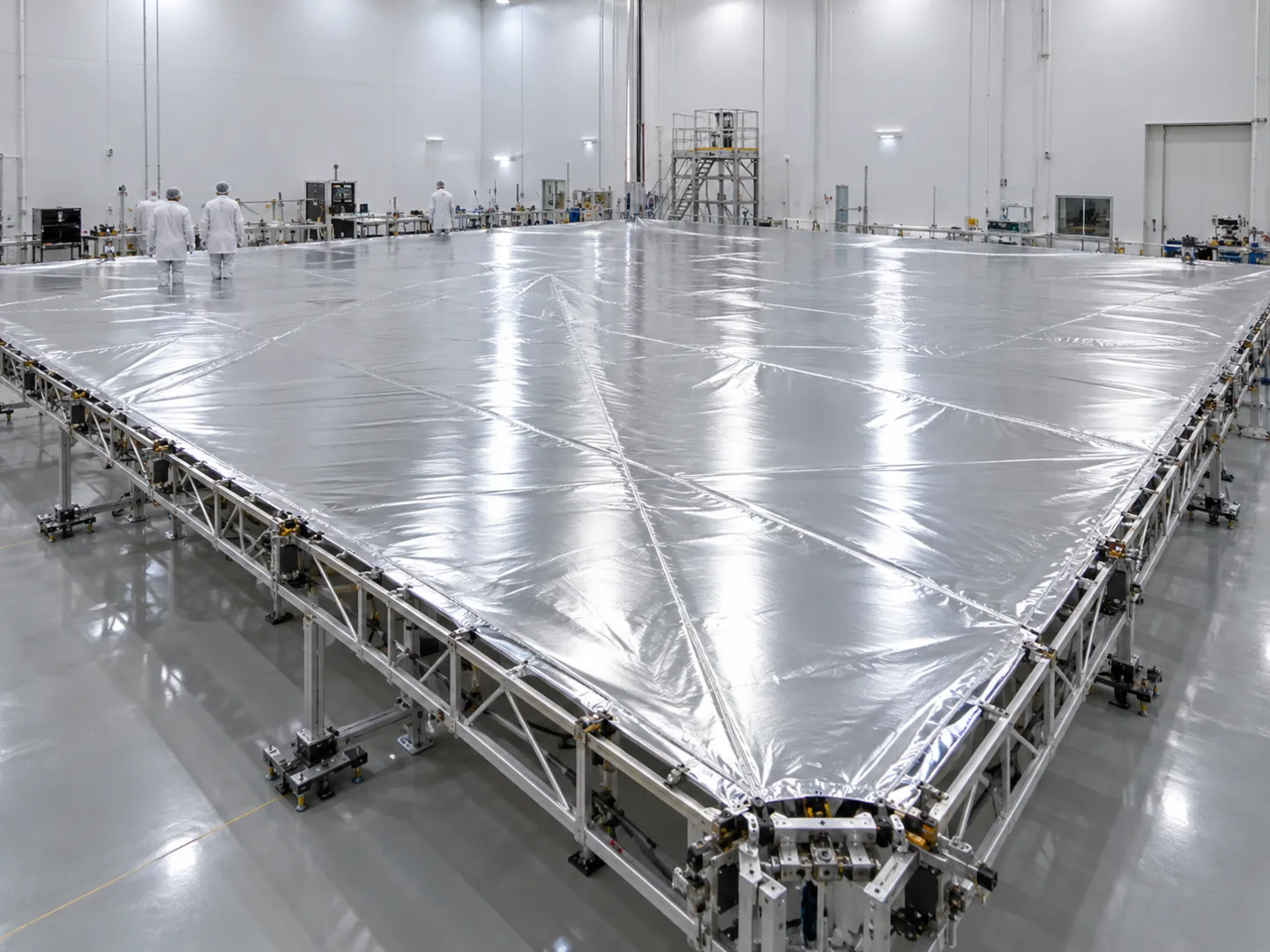
The James Webb Space Telescope's sunshield is roughly the size of a tennis court, with five layers each thinner than a human hair, elaborately folded to fit in the rocket's nose cone.
See the numbersTUBES
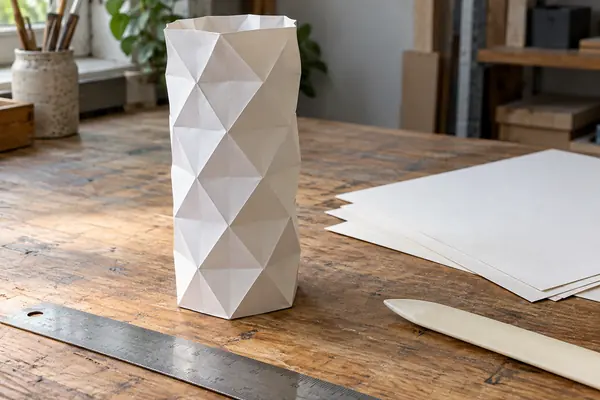
A tube folded from waterbomb bases gets shorter and narrower when compressed. That unusual behaviour has led to an expandable stent graft, a worm robot and a shape-changing wheel.
The rules behind it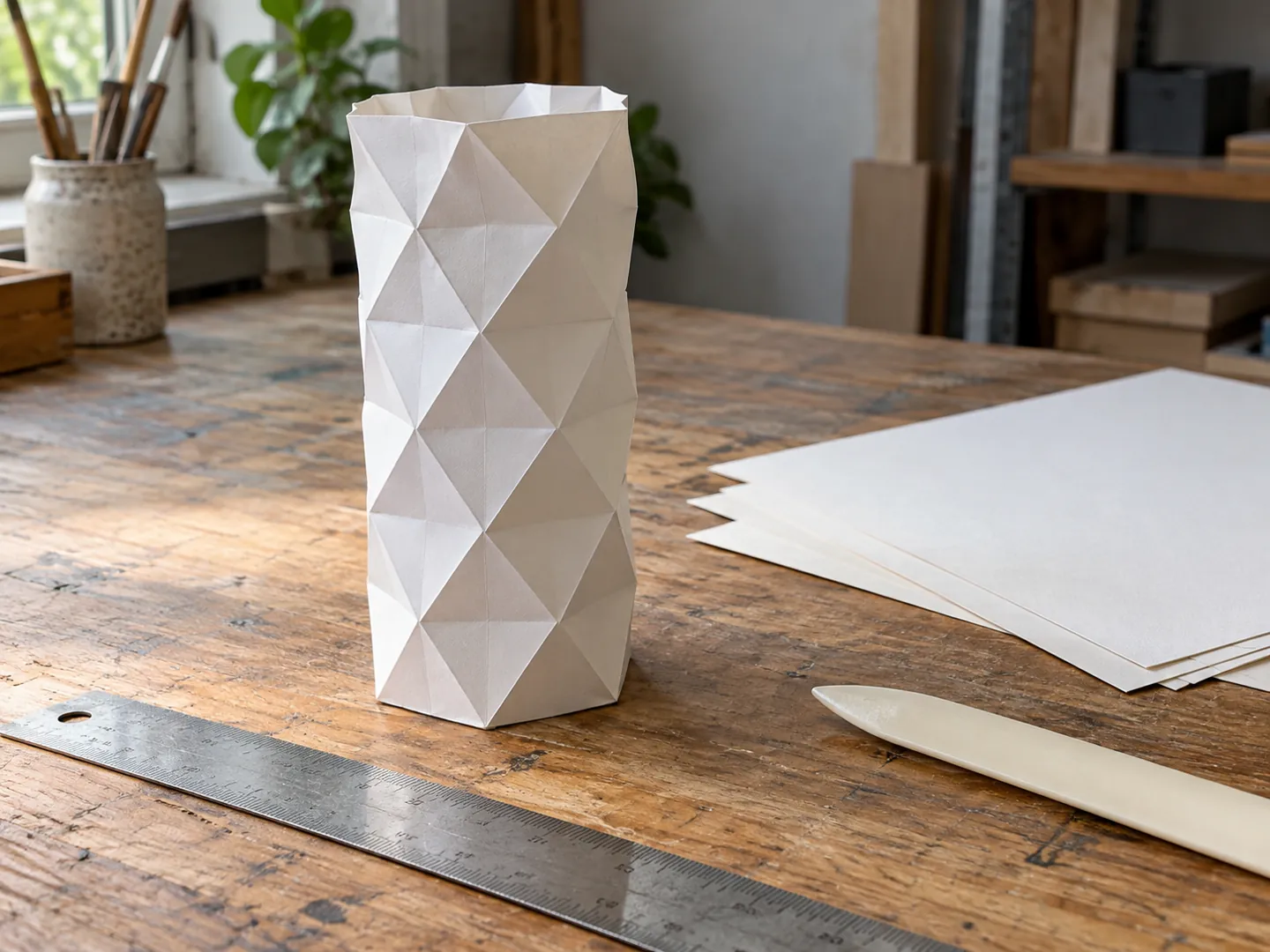
SEE IT ON YOUR DESK
You can check the ideas engineers use with a sheet of paper. These come straight from the rules and patterns in Kyushu University Library's guide to origami science.
A flat sheet flops, but a folded one can stand by itself, and more creases make it stronger. Fold a sheet into a zigzag and try it.
Fold something flat, open it and look at any point where creases meet. The number of mountain folds and valley folds always differs by two.
Look at a Miura-folded map or make the zigzag grid of parallelograms. Pull on one corner and the whole sheet opens in a single motion.
TWO NUMBERS WORTH KNOWING
One prototype on Earth,
one sunshield in space.
2.7 → 25 m
Folded diameter to open diameter
An origami-inspired solar array designed by JPL and Brigham Young University folds to 8.9 feet (2.7 metres) across and unfolds to 82 feet (25 metres), opening like a blooming flower.
SOLAR ARRAY DESIGN · NASA JPL AND BYU
69.5 × 46.5 ft
Size of a sunshield folded into a rocket
NASA gives the sunshield's dimensions as 21.197 by 14.162 metres. Its five layers cut the temperature between the hot and cold sides by about 299°C.
SUNSHIELD · JAMES WEBB SPACE TELESCOPE
JPL notes that thick materials are harder to fold than paper: designers have to rethink folds to allow for the thickness that builds up at each bend.
PICK A FOLD
Some origami ideas already fly; others are still prototypes. The bar shows how far each one has gone, from tabletop model to working hardware.
From NASA JPL (2014), NASA's Webb sunshield page, Kyushu University Library's origami guide and a 2020 study of waterbomb tubes in the journal Research.
THE RULES BEHIND IT
Two origami artists and researchers, Toshikazu Kawasaki and Jun Maekawa, gave their names to rules for flat folding: at every vertex, mountain and valley folds differ by two, and the alternating sum of the angles must be zero.
Origami had been the subject of serious mathematical analysis only within the previous 40 years, a JPL engineer said in 2014. Because the geometry does not depend on scale or material, the same pattern can shape a map, a stent or a spacecraft part.
In conversation
A crease pattern invented by Koryo Miura, a professor emeritus at the University of Tokyo. Opened, it looks like a grid of parallelograms, and it opens or closes in one motion.
Yes. A Miura-fold solar panel was unfolded on Japan's Space Flyer Unit satellite in 1995, and space solar panels already use simple fan or accordion folds.
NASA describes it as elaborately folded to fit in the rocket's nose cone. It is roughly the size of a tennis court, with five layers each thinner than a human hair.
Origami was designed for paper, which has almost no thickness. With panels, thickness builds up at every bend, so engineers have to rethink the folds.
A six-crease pattern with two mountain creases and four valley creases meeting at one point. Tiled into a tube, it shrinks in both length and radius when compressed.
Each figure on this page comes from the sources below.
ABOUT THIS NAME
doodlefolders.com is part of the DoodleSale portfolio. It isn't in an auction right now, but you can ask about leasing it.